
When fascination with the kingdom of darkness begins to eclipse the advancing Kingdom of God
I Need to Begin With an Important Qualification
I am not calling Jonathan Cahn a false teacher.
I am not saying he is not a Christian. I do not know his heart, and I do not believe Christians should casually make those judgments about people simply because we disagree with them.
In fact, after looking more deeply into Cahn’s ministry, I found something that deserves to be acknowledged: Jonathan Cahn does preach Jesus Christ. He teaches about salvation, the new birth, repentance, discipleship, holiness, the Holy Spirit, and following Messiah. His ministry, Hope of the World, explicitly describes its mission in terms of spreading the Gospel, fulfilling the Great Commission, strengthening believers, and bringing the message of salvation to both Jews and Gentiles. (Hope of the World)
So this article is not an attempt to determine whether Jonathan Cahn is saved.
It is asking a different question:
Should the Church be giving Jonathan Cahn so much of its ear?
More specifically:
What kind of Christian does his most distinctive public message tend to form?
That question has been bothering me.
Something Didn’t Add Up
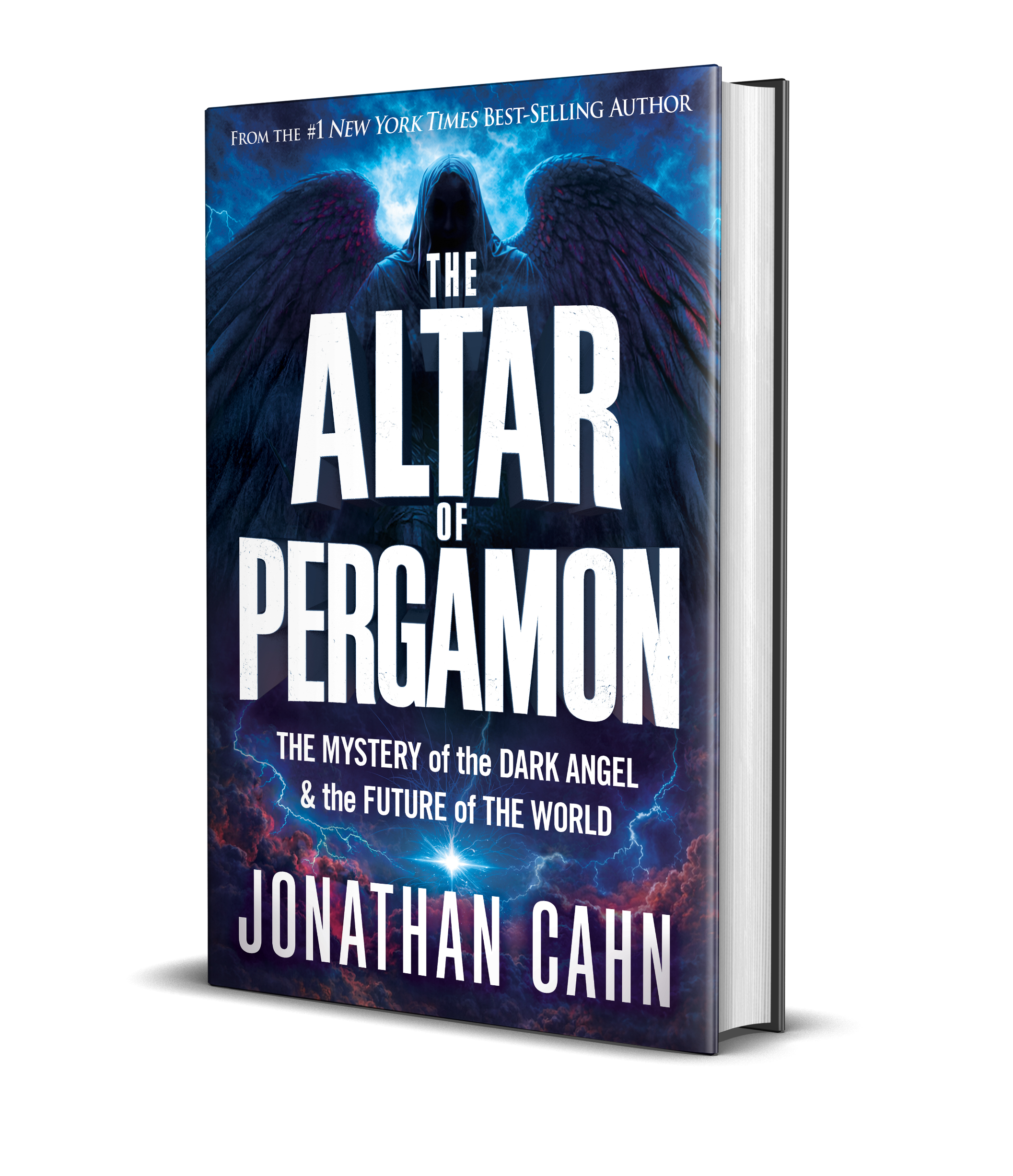
I recently heard Cahn speaking about the Altar of Pergamon.
At first, I didn’t even know Jonathan Cahn was the speaker.
And I was fascinated.
I actually agree with much of the basic premise behind what he was saying. I believe the world is far more spiritual than modern Western culture acknowledges. I believe Scripture when it says that we wrestle not merely against flesh and blood, but against principalities, powers, rulers of darkness, and spiritual wickedness.
I believe Satan deceives.
I believe evil can operate through cultures, institutions, governments, philosophies, and systems.
I believe there is a kingdom of darkness actively opposed to the purposes of God.
So Cahn immediately had my attention.
But the longer I listened, the more something felt wrong.
Not because he was talking about spiritual warfare.
Because some of the historical claims didn’t seem to fit.
One example involved Soviet communism and the Pergamon altar. Cahn connects possession of the altar after World War II with the subsequent empowerment and expansion of Soviet communism.
But communism had seized Russia in 1917.
The Soviet Union had existed for decades before the end of Nazi Germany.
And Hitler himself regarded Marxism and Bolshevism as mortal enemies. The Nazis persecuted German communists from the beginning of Hitler’s rule, and destroying Soviet Bolshevism was one of Hitler’s ideological objectives long before the Soviet army entered Berlin.
So whatever spiritual interpretation one wishes to place upon the Pergamon altar, the historical events themselves do not establish the causal relationship.
That caused me to ask a larger question.
How much of what I am hearing comes from Scripture and established history—and how much comes from Jonathan Cahn connecting the dots?
There is a big difference between saying:
“Perhaps this historical event illustrates a biblical pattern.”
and saying:
“This is the hidden spiritual reality behind what happened.”
The second claim carries a much greater burden.
The Two Jonathan Cahns
As I researched Cahn more broadly, I discovered something I wasn’t expecting.
There really is a Jonathan Cahn who preaches Christ.
His enormous teaching archive includes messages about salvation, Messiah, redemption, discipleship, holiness, prayer, spiritual growth, the Holy Spirit, and ordinary Christian living. Hope of the World catalogs thousands of teachings covering everything from biblical exposition and Christian living to prophecy and current events. (Hope of the World Teaching Archive)
That matters.
It would therefore be unfair to describe Cahn’s entire ministry as nothing more than sensational prophecy.
But there seems to be another Jonathan Cahn—the Jonathan Cahn most of the American Christian public encounters.
This Cahn is introduced as the man who unlocks mysteries.
His own official biography emphasizes his bestselling prophetic books and describes him as being known for opening the deep mysteries of Scripture and bringing messages of prophetic significance. (Jonathan Cahn Official Biography)
His books repeatedly promise the discovery of previously hidden connections.
His promotional material for The Altar of Pergamon presents an ancient mystery connecting empires, revolutions, wars, supernatural forces, and the direction of the modern world. The marketing invites readers to get a peek into the mystery. (Jonathan Cahn Books)
His teaching catalog similarly presents Cahn as one who opens deep biblical mysteries and prophetic revelations.
And even membership in his ministry is promoted partly through special teachings, prophetic updates, biblical mysteries, and messages available to supporters. (Hope of the World Membership)
That creates an unusual dichotomy.
There is Cahn the pastor, proclaiming Messiah and encouraging believers to follow God.
And there is Cahn the prophetic personality, revealing the hidden spiritual machinery behind world history.
Which Cahn has captured the attention of the American Church?
I think we know the answer.
What Is the Fruit?
Jesus warned us about false teachers.
But He did not tell us that discerning them required reading their minds.
He said:
“You will know them by their fruits.”
That is a much more useful test.
Instead of asking whether Jonathan Cahn secretly wants money, fame, or influence—questions we cannot answer—we can ask what his teaching produces.
Does prolonged exposure to this message make Jesus bigger?
Does it produce Christians who know Christ more deeply?
Does it produce evangelism?
Discipleship?
Missionaries?
Churches?
Reconciliation?
Holiness?
Courage?
Care for the poor?
Freedom from sin?
Love of enemies?
Kingdom creativity?
Or does it primarily produce Christians who know considerably more about Satan’s plans?
That distinction matters.
Because it is possible to be well informed about the kingdom of darkness while being poorly equipped to advance the Kingdom of God.
The Enemy Takes This War Seriously
I do believe Christians should understand spiritual warfare.
Paul explicitly says that we should not be ignorant of Satan’s schemes.
Sometimes learning how intentionally evil operates can actually awaken us.
It can remind us:
We are in a war.
The enemy takes that war seriously.
And perhaps Christians should take it more seriously too.
But knowing the enemy’s battle plan should cause us to ask:
What is Jesus’ battle plan?
That is where much modern prophecy teaching seems strangely deficient.
We hear enormous amounts about what Satan is doing.
Global systems.
Apostasy.
Antichrist.
Cultural collapse.
Demonic agendas.
Government corruption.
The takeover of institutions.
The fall of America.
The approaching darkness.
And eventually the Christian imagination begins to absorb a particular story:
The kingdom of darkness is advancing.
The Church is losing.
Everything will continue deteriorating.
Our task is to hold on.
Eventually Jesus will return and rescue whoever remains.
That may be one of the most consequential ideas the modern Church has accepted.
Because it produces an entirely different kind of disciple.
Which Kingdom Has No End to Its Increase?
Isaiah prophesied concerning Messiah:
“Of the increase of His government and peace there shall be no end.”
— Isaiah 9:7
Whose government continually increases?
Whose Kingdom knows no end to its expansion?
Not Satan’s.
Christ’s.
And yet much Christian end-times teaching produces exactly the opposite imagination.
The story becomes one in which the kingdom of darkness expands throughout history while the Kingdom of God progressively contracts.
Satan gains institutions.
Satan gains nations.
Satan gains culture.
Satan gains the next generation.
The Church becomes weaker.
The faithful become fewer.
Darkness eventually dominates almost everything.
Then Jesus finally arrives to rescue His defeated people.
But that is difficult to reconcile with the larger movement of the New Testament.
Jesus says:
“I will build My church, and the gates of Hades shall not prevail against it.”
Gates are defensive structures.
The picture is not primarily of a Church desperately keeping hell outside its walls.
It is of Christ building something against which the defenses of hell cannot ultimately stand.
Daniel sees a stone become a mountain that fills the earth.
Jesus describes His Kingdom as mustard seed becoming a great plant.
He describes it as leaven working through the whole lump.
Paul says Christ must reign until He has put all enemies beneath His feet.
The last enemy is death.
Christ is not waiting to begin reigning after history ends.
He reigns now.
Read Acts Again
The Roman world into which the apostles walked was hardly friendly to Christianity.
It was filled with pagan temples, sexual immorality, emperor worship, occult practices, political oppression, slavery, infanticide, and demonic religion.
If anyone had reason to become obsessed with the advancing kingdom of darkness, it was the early Church.
But read Acts.
The Church does not spend Acts cataloging Rome’s wickedness.
The Church moves.
It preaches.
It heals.
It casts out demons.
It plants churches.
It crosses ethnic barriers.
It cares for widows.
It sends missionaries.
It confronts idols.
It enters cities.
It announces that Jesus Christ is Lord.
And again and again Luke gives us almost defiant summaries:
The Word of God increased.
The Gospel increased.
The disciples multiplied.
Even under persecution.
Even after martyrdom.
Even while kings opposed them.
The darkness was real.
But darkness was not the main character.
Jesus was.
Spiritual Warfare Is Not Defensive
This changes how we understand spiritual warfare.
The purpose of the armor of God is not to equip Christians to hide in a bunker until the evacuation helicopter arrives.
Paul puts armor on believers—and then immediately asks them to pray that he would boldly proclaim the Gospel.
The armor protects an advancing mission.
We are not fighting to determine whether Jesus will win.
The throne is already occupied.
Christ has already been raised.
Christ has already been enthroned.
Christ has already disarmed principalities and powers.
Christ has already been given all authority in heaven and on earth.
The question is not whether Satan can ultimately overthrow Jesus.
The question is whether the Church will faithfully participate in the reign and mission of the King who has already conquered.
That produces a very different posture.
Not frightened.
Not passive.
Not naïve.
Not unaware of evil.
But confident.
Creative.
Sacrificial.
Missionary.
Kingdom-minded.
Intelligence Reports Are Not Battle Plans
This may be the simplest way I know to explain my concern about ministries built around prophetic mysteries.
Suppose Jonathan Cahn is correct about Pergamon.
Suppose he is correct about some hidden spiritual connection behind twentieth-century history.
Suppose we learn something genuine about Satan’s strategy.
Fine.
Now what?
Does someone become born again because of it?
Does a father disciple his children differently tomorrow?
Does somebody forgive an enemy?
Does a church plant another church?
Does somebody feed the hungry?
Does a Christian build something beautiful?
Does someone overcome pornography?
Does a missionary go to an unreached people?
Does a businessman conduct his company as an outpost of Christ’s Kingdom?
Does someone who has never heard the Gospel hear it?
An army can possess thousands of pages of intelligence about the enemy and still lose every battle if nobody ever receives orders from the King.
Information about the enemy is useful.
But intelligence reports are not battle plans.
The Danger of Hidden Knowledge
There is another problem.
The more Christianity becomes centered on hidden revelation, the more dependent Christians can become upon the person who possesses that revelation.
The pattern becomes:
There is a secret.
Most Christians don’t know it.
Current events cannot be understood without it.
An ancient biblical mystery explains everything.
The teacher has uncovered it.
And the next book will reveal it.
I am not accusing Jonathan Cahn of consciously constructing a scheme to enrich himself.
I cannot know that.
But structurally, that model can create dependency.
The Christian begins asking:
“What has Jonathan uncovered next?”
rather than:
“What is Christ saying to His Church?”
That is worth examining carefully.
Because healthy Christian ministry should ultimately make the minister smaller.
John the Baptist said:
“He must increase, but I must decrease.”
Paul said:
“Him we proclaim.”
The treasure is Christ.
If the teacher disappears, the treasure remains.
So Should We Give Jonathan Cahn Our Ear?
Perhaps.
But not uncritically.
Cahn may identify genuine spiritual realities.
His warnings may awaken complacent Christians.
His understanding of the supernatural may challenge a Western Church that has sometimes become functionally materialistic.
There may be things worth hearing.
But Jonathan Cahn should never become the lens through which Christians interpret reality.
Scripture already gives us that lens.
And Christ Himself must remain the center.
A useful test might be this:
After listening to Jonathan Cahn for a year, has your understanding of Satan become larger—or has your understanding of Jesus become larger?
Do you talk more about what darkness is doing?
Or what Christ is doing?
Are you more afraid of the future?
Or more convinced that Jesus is King?
Are you waiting for rescue?
Or advancing the mission He already gave you?
Are you obsessed with the enemy’s strategy?
Or consumed with the King’s?
That is the question that matters to me.
I do not need to decide whether Jonathan Cahn is a false teacher in order to decide whether I should give him my attention.
Attention is precious.
And whatever repeatedly receives the Church’s attention will eventually shape the Church’s imagination.
The kingdom of darkness is real.
We should not be ignorant of it.
But it does not deserve to dominate the Christian imagination.
Jesus does.
The Church’s great message is not:
“Look how successfully Satan is taking the world.”
It is:
Jesus Christ is Lord.
His Kingdom has come.
His Kingdom is coming.
His government is increasing.
His Gospel is still the power of God unto salvation.
His Spirit still lives in His people.
The gates of hell still cannot prevail against His Church.
And the final outcome has never been in doubt.
So learn the enemy’s plans when necessary.
But spend your life carrying out the King’s.